
More than two weeks after a wall collapsed in suburban Mumbai, killing 30 people and injuring more than 100, Rediff.com's Prasanna D Zore and Hitesh Harisinghani visit the area to know how the survivors devastated by the deluge are coping with their lives.

'I don't think he would have ended his life if he knew that people loved him so much.'

'There is a clear business impact. People are avoiding crowded places and gatherings across cities. This is hitting business, both at traditional and modern trade outlets, during the Holi season, which kicked off from Saturday,' says Praveen Khandelwal, general secretary, Confederation of All India Traders (CAIT).

The suburban location of Mumbai's Goregaon registered the biggest decline in average weighted basic sale price at 20 per cent.

'People are getting admitted to hospital two to three days before their death in a very serious respiratory compromise state and they are passing away within 48 hours.' 'Those who are coming early in the disease, the minute they are suspicious that they have COVID-19, the recovery rate has been much, much, higher.' 'The moral of the story is: We must destigmatise COVID-19.' 'People should be told: 'Look, if you have anything like this, please come immediately'.'

'The mental issues are too complex to be handled.' 'It is hitting us hard for one reason.' 'We have such a high level of fear about this disease.'

With as many as 2,30,599 COVID-19 cases, Maharashtra continues to remain the worst-affected state, followed by Tamil Nadu (1,26,581) and Delhi (1,07,051).

Acid attack survivor Lalita ties the knot with Rahul Kumar at a dream wedding.

The death toll climbed to 20,160 as 467 more people succumbed to the disease.
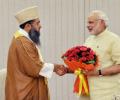
The least the leaders who met Prime Minister Narendra Modi could have done was to highlight the plight of the Muslim riot victims, but they happily chose to ignore it, so privileged they must have felt to be in the presence of the prime minister, the most powerful man in the country, says Syed Firdaus Ashraf.

'Around the same time, I watched Rock On!! where those guys have that midlife crisis.' 'They are busy with their corporate jobs and then they want to start singing again.' 'Seeing that, I got a boost.' 'I felt if I don't give acting a full chance again, I will regret it.' 'So I decided to quit my job and pursue acting full time.'

'I do drama with the same intensity as any comedy.'

This was the third consecutive day that COVID-19 cases in the country have increased by more than 26,000.
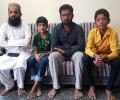
One teenager died in police firing last May. Another teenager is paralysed waist down. Both families have been ignored by the political establishment, including the AIMIM.
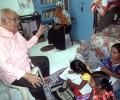
Jyoti Punwani pays tribute to Syed Feroze Ashraf, the eternal do-gooder who changed the lives of many children.

A large number of people took out a 'solidarity march' in South Delhi on Sunday in support of Jamia Millia Islamia students and those facing police action during protests against the contentious law.

Single mother Gauri Sawant hopes to change the way people view transgenders in India.

'My mother has one complaint -- I die in all of my films. She has told me to stop dying now.'

'We will never really lose him because in death, his spirit, trapped in a frail body, has been set free and will surround us like the air we breathe.'
'I've seen the craze for English education even among the poorest. But that is only for their sons. Parents feel thrilled when they see their sons going to school wearing a tie. They don't mind paying for their sons' private tuitions too.' 'But daughters are sent to municipal schools, madarsas, small schools where teachers with no teaching skills are paid Rs 2,000 or Rs 4,000. That's why more girls come to my class.' Syed Feroze Ashraf, who has sent 500-odd girls (and a few boys) -- all first generation learners, children of grave-diggers, hawkers, rickshaw-drivers, tailors and watchmen -- to college, speaks to Jyoti Punwani. A Rediff.com Special.
 © 2026 Rediff.com - Advertise with us - Disclaimer - Privacy Policy - Sitemap - Feedback - About us - Terms of use - Grievances